
Trapping the future with light can push boundaries of biology, medicine & nanoscience

Trapping the future with light can push boundaries of biology, medicine & nanoscience
While trying to examine forces on single biomolecules with great precision, researchers have solved their requirement of a dual trap optical tweezers system by inventing their own version of the tool, making the technology accessible to scientists in India. This could ignite a wave of new discoveries not only in neuroscience, but also in areas like drug development and other medical research.
Optical tweezers, a discovery that won the Nobel Prize in 2018, have become a key tool in modern research, allowing for the manipulation and movement of extremely small objects using light. Their application to measure minuscule forces has been useful in many disciplines including biology, bioengineering, materials science, and nanotechnology.
Decades after the invention of optical tweezers, some designs still face the challenge of versatility for current applications. Interactions between trapped micron-sized particles, mechanical properties of biopolymer filaments, and force generation by protein nanomachines are most often researched in a dual-trap system, where two beams are used to control the trapped particles. But there is a problem: traditional systems rely on detecting light that passes through the trapped particles, and this method has limitations.
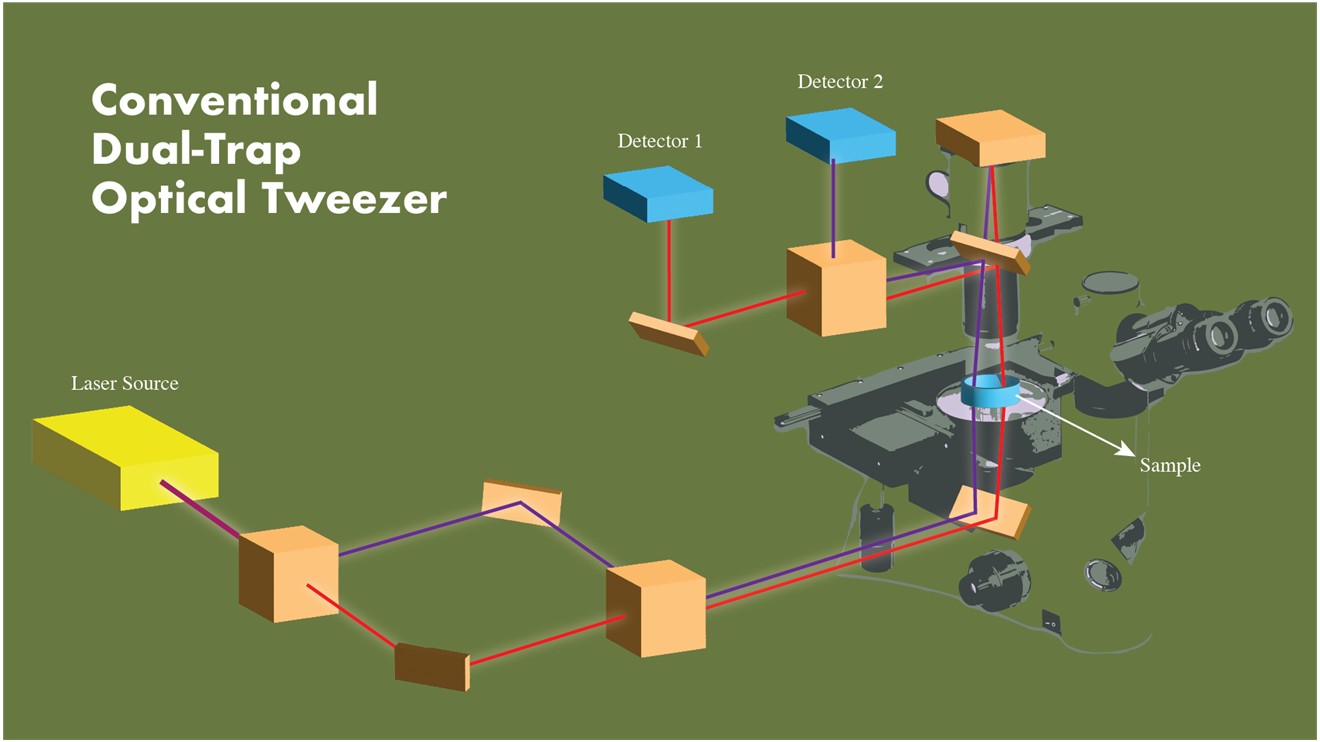
Fig 1: Conventional Dual-Trap Optical Tweezer set-up
Raman Research Institute, an autonomous institute supported by the Department of Science and Technology (DST), Government of India, has worked out a new optical trapping scheme which overcomes the shortcomings of traditional dual-trap optical tweezers. The novelty is in using a confocal detection scheme, a system where each detector looks only at the light coming back from its own trap, and ignores everything else. This way, the signals from two traps do not interfere with each other and stay completely independent.
Most remarkably, the detectors used for sensing the particle position within the traps remain perfectly aligned even when the traps are in motion. By eliminating all signal interference, the system provides for each trap to provide distinct, reliable measurements.
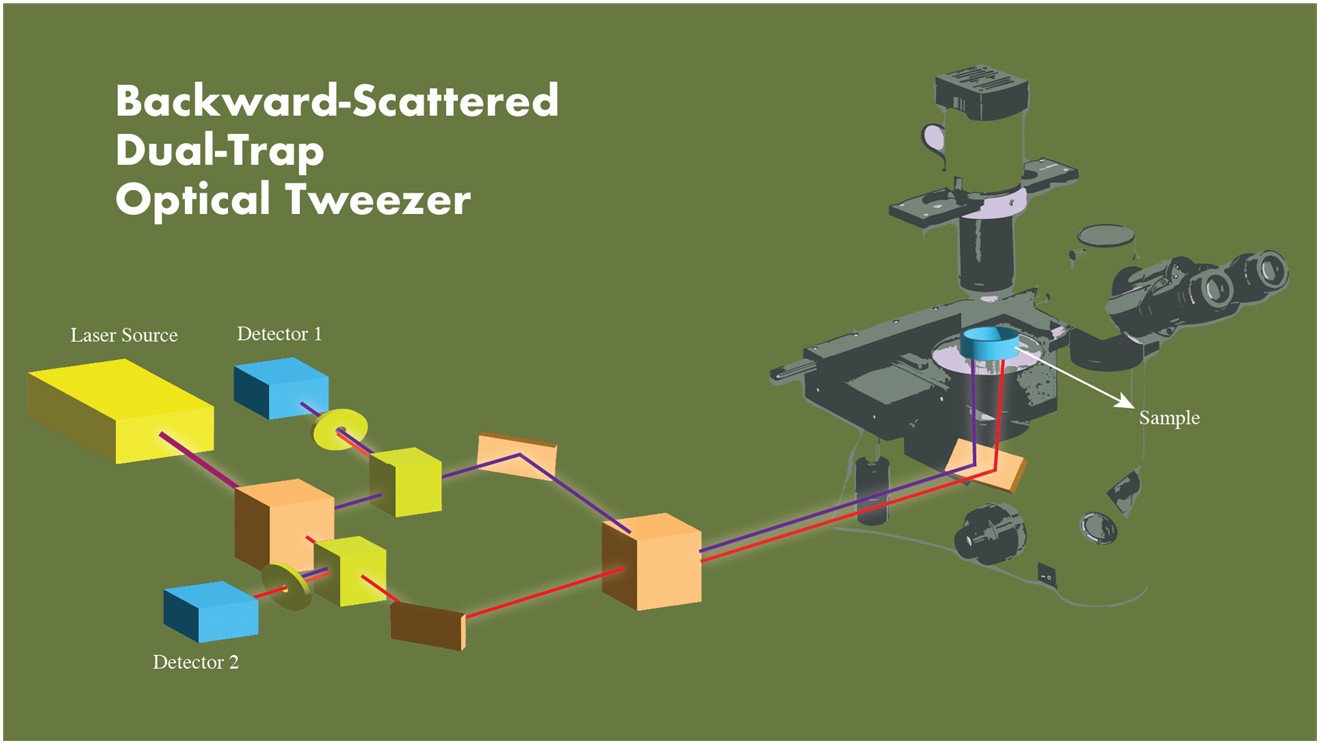
Fig 2: The novel Dual-Trap Optical Tweezer set-up using backward-scattered light
“The unique optical trapping scheme utilizes laser light scattered back by the sample for detecting trapped particle position. This technique pushes past some of the long-standing constraints of dual-trap configurations and removes signal interference and the single module design integrates effortlessly with standard microscopy frameworks,” said Md Arsalan Ashraf, PhD Scholar at RRI.
Traditional designs use the trapped objects’ position measured by light that travels through them. Although effective, this does three things badly. First, there is signal interference where the signals from the two traps when they are operating together. Engineers have tried to reduce this form of interference, ‘cross-talk’ using separate lasers or more complex optics which increases the cost and the system’s sophistication. Furthermore, these systems often try to take over the other components of the microscope, and things like phase contrast or fluorescence imaging become more difficult to incorporate. Third, upon movement of traps, the detection system must be repositioned. This contributes to downtime and diminishes accuracy in dynamic experiments.
This new design innovated by RRI scientists is not only conceptually better, it is also more versatile. There is no cross-talk, and measurements from the two traps do not interfere with each other even when the traps are brought close together. Traps can be displaced freely without losing the ability to track the particles, and the system is stable for extended times, even under temperature variation. The system works seamlessly with existing imaging techniques, requiring no modifications. Its compact and modular design allows it to be easily added to a regular microscope without changing the microscope’s basic structure.
“This new single module trapping and detection design makes high precision force measurement studies of single molecules, probing of soft-materials including biological samples, and micromanipulation of biological samples like cells much more convenient and cost effective.” said Pramod A Pullarkat, lead PI & faculty at RRI.
From an intellectual property perspective, this design is unique in how dual optical traps can be employed. It elegantly solves the persistent challenge of signal interference in a minimalistic manner, improving precision and reliability while enhancing robustness and integration. All of these factors make it an excellent candidate for patent protection.
Leveraging this foundation, the authors are now interested in commercializing this dual-trap technique as a single module add-on product for existing commercial microscopes with plug-and-play capabilities.