
FIRST PRESS RELEASE OF CONSUMER PRICE INDEX ON BASE 2024=100
Posted On: 12 FEB 2026 4:00PM by PIB Delhi
| What’s New
Base revised from 2012 to 2024 using Household Consumption Expenditure Survey 2023-24 12 Divisions in place of 6 Groups in accordance to Classification of Individual Consumption According to Purpose (COICOP) 2018 Release of All India and State level Item indices for rural, urban and combined sectors New Additions: Rural housing, Online media service provider/Streaming services, value added dairy products, Barley & its product, Pen-drive & External Hard disk, Attendant, Babysitter and Exercise equipment Items Removed: VCR/VCD/DVD player and hiring charges, Radio, Tape recorder, Clothing second-hand, CD/DVD audio/video cassettes and Coir/rope |
The Ministry of Statistics & Programme Implementation is releasing the Consumer Price Index (CPI) with Base 2024=100. The item basket and the corresponding weights are based on Household Consumption Expenditure Survey 2023-24. The exercise is being done for enhancing the coverage and representativeness of the inflation measure. The revision introduces more granular data enabling policymakers, financial institutions, businesses and citizens with precise data-driven decisions.
- Key Statistics
- National Level Indices
-
- Year-on-year inflation rate based on All India Consumer Price Index (CPI) with base year 2024 for the month of January, 2026 over January, 2025 is 2.75%(Provisional). Corresponding inflation rates for rural and urban are 2.73% and 2.77%, respectively.
| January, 2026 (Provisional) at Base year 2024=100 | ||||
| Rural | Urban | Combined | ||
| Inflation (%) | CPI (General) | 2.73 | 2.77 | 2.75 |
| CFPI | 1.96 | 2.44 | 2.13 | |
| Index | CPI (General) | 104.59 | 104.30 | 104.46 |
| CFPI | 103.89 | 104.31 | 104.04 | |
-
- Food Inflation: – Year-on-year inflation rate based on All India Consumer Food Price Index (CFPI) for the month of January, 2026 over January, 2025 is 2.13% (Provisional). Corresponding inflation rates for rural and urban are 1.96% and 2.44%, respectively.
- Housing Inflation: – Year-on-year Housing inflation rate for the month of January, 2026 is 2.05% (Provisional)and the corresponding inflation rates for rural and urban are 2.39% and 1.92%, respectively.
-
- At National level, division wise inflation for the month of January, 2026 in the Combined sectors may be seen from the graph below-
-
- All India General CPI and CFPI with base year 2024 for the Combined sectors from January, 2025 to January, 2026 is given below-
| Month | CPI | CFPI |
| Jan-25 | 101.67 | 101.87 |
| Feb-25 | 101.32 | 100.40 |
| Mar-25 | 101.39 | 100.27 |
| Apr-25 | 101.58 | 100.18 |
| May-25 | 101.90 | 100.54 |
| Jun-25 | 102.51 | 101.74 |
| Jul-25 | 103.35 | 103.67 |
| Aug-25 | 103.74 | 104.49 |
| Sep-25 | 103.74 | 104.12 |
| Oct-25 | 103.74 | 103.94 |
| Nov-25 | 104.01 | 104.45 |
| Dec-25 | 104.10 | 104.09 |
| Jan-26 | 104.46 | 104.04 |
-
- Top 5 items with low inflation at All India combined level in January, 2026 are given in table below:
| S.No. | Item
|
Weight | Inflation (%) | |
| 1 | Garlic | 0.3738
|
-53.05 | |
| 2 | Onion | 0.7006
|
-29.27 | |
| 3 | Potato | 0.7549
|
-28.98 | |
| 4 | Arhar, Tur | 0.5333
|
-24.90 | |
| 5 | Peas | 0.1254
|
-15.56 | |
-
- Top 5 items with high inflation at All India combined level in January, 2026 are given in table below:
| S.No. | Item | Weight | Inflation (%)
|
|
| 1 | Silver Jewellery | 0.3127
|
159.67 | |
| 2 | Tomato | 0.4961
|
64.80 | |
| 3 | Coconut: copra | 0.0854
|
47.18 | |
| 4 | Gold/Diamond/Platinum Jewellery | 0.6230
|
46.77 | |
| 5 | Coconut oil | 0.0579
|
40.44 | |
-
- The month over month (MoM) change in CPI and CFPI from January, 2025 to December, 2025 in CPI 2024 series is given in the following graph:
- State level Indices
Top five States (having more than 50 lakhs population as per Census 2011) with highest inflation in January, 2026 are given below-
- December 2025 (Final) figures for CPI base 2012=100
All India CPI, CFPI and corresponding inflation rates for the month of December 2025 (Final) with base year 2012 are given as follows-
| December, 2025 (Final) at Base 2012=100 | ||||
| Rural | Urban | Combined | ||
| Inflation (%) | CPI (General) | 0.76 | 2.03 | 1.33 |
| CFPI | -3.03 | -2.09 | -2.71 | |
| Index | CPI (General) | 199.9 | 195.9 | 198.0 |
| CFPI | 198.5 | 205.9 | 201.1 | |
-
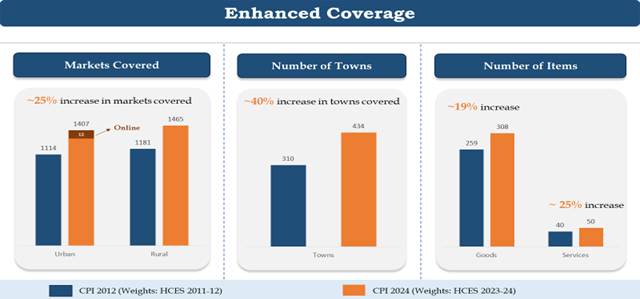
Response Rate- Real time price data are collected from selected 1407 urban Markets (including online markets) and 1465 villages covering all States/UTs through personal visits by field staff of Field Operations Division of NSO, MoSPI on a weekly roster. During the month of January, 2026, prices were collected from 100% rural and urban markets while the market-wise prices reported therein were 100% for rural markets and 99.98% for urban markets. CPI for February 2026 will be released on 12th March, 2026 (Thursday) or the next working day in case of 12th being a holiday.
Detailed indices including granular level indices (State and Item wise) for the year 2025 and January 2026 may be downloaded from eSankhyiki portal of MoSPI- https://esankhyiki.mospi.gov.in/
State-level item indices, available on the portal, should be interpreted cautiously in view of thin samples of price used for index compilation in some of the cases.
- Technical Note on Base Updation Exercise of Consumer Price Index (CPI) (Base 2024=100)
Background and Rationale
The Consumer Price Index (CPI) series with base year 2024=100 has been introduced to ensure that the index remains representative of current household consumption patterns, price structures, and the evolving nature of the Indian economy. The previous CPI series with base 2012=100 served as a stable and reliable measure for more than a decade; however, during this period, significant structural changes have occurred in consumption behaviour, income levels, urbanisation, expansion of the services sector, and digitalisation.
The base updation exercise has been undertaken on the basis of the latest Household Consumption Expenditure Survey (HCES) 2023–24, which provides comprehensive information on household expenditure patterns across rural and urban areas of the country.
Expert Group and Consultative Process
An Expert Group on Base Revision of CPI was constituted with representation from the Reserve Bank of India, academia, line Ministries, and statistical experts.
The Expert Group examined methodological, coverage, classification and data-related aspects of CPI revision. In addition, extensive consultations were undertaken through pre-consultative workshops, interactions with key stakeholders and public discussion papers. To understand the global best practices for refining methodology and incorporating alternative data sources, consultations with International Monetary Fund, World Bank and UNECE’s Group of Experts have also been done.
Reference Period and Base Year Selection
For any price index to be robust and analytically sound, the price reference period should be as close as possible to the weight reference period. In CPI 2024, expenditure weights are derived from HCES 2023–24, while base-period prices were collected during January 2024 to December 2024.
Accordingly, 2024 has been selected as the base year, ensuring close alignment between the weight reference period and the price reference period, thereby improving internal consistency and representativeness.
Revision of Item Basket and Coverage
At the all-India level, the number of weighted items has increased from 299 to 358 in CPI 2024. Within this:
- Goods items are increased from 259 to 308
- Services items are increased from 40 to 50
This expansion strengthens the representation of the services sector, which has assumed greater importance in household expenditure over time.
Key enhancements:
- First-time inclusion of rural house rent for improving coverage of rural housing consumption
- Strengthened representation of modern consumption items such as online media services and fuels (CNG/PNG)
- Improved coverage of data available on digital and administrative sources, including telephone charges, rail fare, air fare, fuel, postal charges and online media and streaming services (OTT subscriptions).
Adoption of International COICOP – 2018 Framework
The CPI 2024 series adopts the Classification of Individual Consumption According to Purpose (COICOP) 2018, replacing the earlier structure comprising six broad groups. This is the latest classification system developed by United Nations Statistics Division. Under the revised framework, expenditure is classified into 12 divisions at the first level, 43 groups, 92 classes, 162 subclasses enabling and 358 items at last level of hierarchy which enables:
- Classification of items according to its usage
- Ensures global comparability of India’s CPI
- Enables more granular dissemination of indices and inflation rates
Revised Weights and Weighing Diagram
The revised weights reflect updated household expenditure patterns as captured in HCES 2023–24. Share of Food & Beverages is declined in the new series, however, it continues to remain the largest component of the CPI basket.
A diagrammatic presentation of the revised weighing structure, showing division-wise shares for CPI 2012 (Base 2012=100) and CPI 2024 (Base 2024=100), is provided to illustrate changes in relative importance across major consumption groups. The revised weighing diagram highlights:
- Declining food share in household expenditure
- Importance of housing, services, and transport-related items
- Better alignment with current consumption behaviour
Month-over-Month change in General CPI during 2025 with 2012 as base year vis-à-vis with 2024 as base year
Price Collection Methodology and Digitalisation
As part of the base updation exercise, the CPI 2024 series marks the introduction of Computer Assisted Personal Interviewing (CAPI) for price data collection. Under CAPI, price data are collected electronically using handheld devices with in-built validation checks, standardized item specifications, and real-time monitoring capabilities. The transition to CAPI enhances data quality, timeliness and consistency.
Physical market price collection continues to form the backbone of CPI compilation. However, to reflect changing purchasing behaviour, the CPI 2024 series supplement traditional collection with alternative data sources:
- E-commerce prices introduced as an additional market in 12 large towns (population exceeding 25 lakhs)
- Online sources for select services such as airfares and OTT subscriptions
- Administrative data for standardized services such as rail fares, postal charges and fuel prices
Clear item specifications and defined price collection protocols are followed to ensure comparability and consistency.
Housing Index Compilation
In the revised CPI series, the Housing index is compiled using a weighted average of three constituent groups, namely “actual rental payments for housing”, “maintenance, repair and security of the dwelling”, and “water supply and other miscellaneous services” relating to the dwelling. Housing inflation is thereafter computed on a year-on-year basis based on the resulting composite Housing index.
Compilation of combined index
Combined indices at all levels have been calculated by taking the weighted average of rural and urban indices with corresponding rural and urban weights.
Linking Factor and Back Series
To facilitate continuity and ease of analysis on the basis of time series data, CPI 2024 series is being released along with following back series data;
- Linking factors between CPI 2012 and CPI 2024 series
- All India General Indices for Rural, Urban and Combined sectors for the period of January 2013 to December 2024.
- Annual Inflation rates based on all India General Indices for Rural, Urban and Combined sectors for the period of January 2014 to December 2024
Calculation of linking factor: A linking factor is calculated to connect the two series over a common overlapping period. The overlapping period here is 2025, during which both CPI 2012 and CPI 2024 indices are available. This overlapping year forms the basis for linking the two series.
Formula for CPI Linking Factor (Annual Overlapping) is as follows:
Let Avg Iynew : denote the annual average (Geometric mean) CPI of the new series for the overlapping year y;
Avg Iyold : denote the annual average (Geometric mean) CPI of the old series for the same overlapping year y.
The Linking Factor (LF) is given by:
LF = Avg Iynew / Avg Iyold
The linked CPI for the earlier month t is obtained as:
Itlinked = ItOld × LF (where month t implies earlier period than y)
ItOld is the CPI for month t from the CPI 2012 series and Itlinked is the corresponding CPI for month t with base 2024. y denotes year 2025.
Following linking factor is used to calculated back series at general level;
| S. no. | CPI General | Linking factor |
| 1. | Rural | 0.5222 |
| 2. | Urban | 0.5320 |
| 3. | Combined | 0.5267 |
The CPI 2024 series is based on the latest Classification of Individual Consumption According to Purpose (COICOP-2018) framework of UNSD, whereas the CPI 2012 series followed a different classification system. Due to these differences, the two series can be directly linked only for general index level.
Conclusion
The CPI 2024 series represent a comprehensive strengthening of India’s inflation measurement framework. Through updated weights, expanded coverage, improved classification, and incorporation of modern data sources, the revised CPI provides a more representative, transparent and methodologically robust measure of retail price change, aligned with international best practices and current consumption realities.
- Annexures
| Annexure | Title |
| I | All India General (Rural, Urban and Combined) division wise indices and inflation for January, 2026 (Provisional) |
| II | All India General (Rural, Urban and Combined) group wise indices and inflation for January, 2026 (Provisional) |
| III | State wise general index and inflation in January, 2026 (Provisional) |
| IV | State level (Rural, Urban and Combined) index from January 2025 to December, 2025(downloadable table) |
| V | Frequently Asked Questions on CPI 2024 |
Annexure- I
All India General (Rural, Urban and Combined) division wise indices and inflation for January, 2026 (Provisional)
| Division code | Division name | Index | Inflation | ||||
| Rural | Urban | Comb. | Rural | Urban | Comb. | ||
| 01 | Food and beverages | 103.89 | 104.25 | 104.03 | 1.96 | 2.38 | 2.11 |
| 02 | Paan, tobacco and intoxicants | 104.41 | 104.42 | 104.42 | 2.73 | 3.15 | 2.86 |
| 03 | Clothing and footwear | 106.61 | 104.80 | 105.92 | 3.40 | 2.29 | 2.98 |
| 04 | Housing, water, electricity, gas and other fuels | 102.11 | 101.96 | 102.02 | 1.33 | 1.65 | 1.53 |
| 05 | Furnishings, household equipment and routine household maintenance | 103.12 | 102.78 | 102.97 | 1.55 | 1.31 | 1.45 |
| 06 | Health | 103.72 | 104.22 | 103.91 | 2.12 | 2.30 | 2.19 |
| 07 | Transport | 100.67 | 100.61 | 100.64 | 0.12 | 0.06 | 0.09 |
| 08 | Information and communication | 103.54 | 102.99 | 103.30 | 0.23 | 0.07 | 0.16 |
| 09 | Recreation, sport and culture | 103.85 | 104.22 | 104.03 | 2.06 | 2.58 | 2.32 |
| 10 | Education services | 104.77 | 105.71 | 105.33 | 3.08 | 3.53 | 3.35 |
| 11 | Restaurants and accommodation services | 104.77 | 106.56 | 105.71 | 1.98 | 3.66 | 2.87 |
| 13 | Personal care, social protection and miscellaneous goods and services | 123.07 | 122.05 | 122.63 | 19.59 | 18.28 | 19.02 |
| All India | 104.59 | 104.30 | 104.46 | 2.73 | 2.77 | 2.75 | |
Annexure- II
All India General (Rural, Urban and Combined) group wise indices and inflation for January, 2026 (provisional)
| Group code | Group name | Index | Inflation | ||||
| Rural | Urban | Comb. | Rural | Urban | Comb. | ||
| 01.1 | Food | 103.89 | 104.31 | 104.04 | 1.96 | 2.44 | 2.13 |
| 01.2 | Beverages | 103.65 | 103.10 | 103.41 | 1.71 | 1.37 | 1.56 |
| 01.3 | Services for processing primary goods for food | 106.00 | 106.72 | 106.21 | 3.22 | 3.91 | 3.42 |
| 02.1 | Alcoholic beverages | 105.81 | 105.31 | 105.65 | 3.78 | 3.89 | 3.82 |
| 02.3 | Paan and tobacco | 103.17 | 103.49 | 103.26 | 1.78 | 2.38 | 1.96 |
| 03.1 | Clothing | 107.05 | 105.40 | 106.42 | 3.75 | 2.82 | 3.40 |
| 03.2 | Footwear | 103.71 | 101.06 | 102.67 | 1.05 | -1.04 | 0.23 |
| 04.1 | Actual rental payments made for housing | 102.62 | 102.28 | 102.36 | 2.18 | 1.86 | 1.93 |
| 04.3 | Maintenance, repair and security of the dwelling | 105.13 | 104.63 | 104.95 | 3.23 | 3.15 | 3.20 |
| 04.4 | Water supply and miscellaneous services relating to the dwelling | 100.91 | 102.22 | 101.82 | 0.63 | 1.77 | 1.42 |
| 04.5 | Electricity, gas and other fuels | 101.06 | 100.10 | 100.68 | 0.26 | 0.49 | 0.35 |
| 05.1 | Furniture, furnishings, and loose carpets | 104.58 | 103.90 | 104.32 | 2.28 | 1.90 | 2.13 |
| 05.2 | Household textiles | 106.15 | 103.72 | 105.24 | 3.16 | 1.18 | 2.41 |
| 05.3 | Household appliances | 101.17 | 100.18 | 100.71 | 0.18 | -0.65 | -0.21 |
| 05.4 | Glassware, tableware and household utensils | 105.74 | 104.53 | 105.28 | 3.19 | 2.12 | 2.78 |
| 05.5 | Tools and equipment for house and garden | 98.85 | 99.59 | 99.10 | -1.51 | -0.54 | -1.19 |
| 05.6 | Goods and services for routine household maintenance | 102.68 | 103.25 | 102.94 | 1.46 | 1.89 | 1.66 |
| 06.1 | Medicines and health products | 104.40 | 104.38 | 104.39 | 2.52 | 2.15 | 2.38 |
| 06.2 | Outpatient care services | 101.96 | 104.03 | 102.80 | 0.89 | 2.57 | 1.57 |
| 06.3 | Inpatient care services | 103.95 | 104.83 | 104.32 | 2.76 | 3.40 | 3.02 |
| 06.4 | Other health services | 102.23 | 103.00 | 102.52 | 1.16 | 1.81 | 1.41 |
| 07.1 | Purchase of vehicles | 97.34 | 96.65 | 96.99 | -4.32 | -4.73 | -4.53 |
| 07.2 | Operation of personal transport equipment | 100.03 | 100.05 | 100.04 | 0.11 | 0.12 | 0.11 |
| 07.3 | Passenger transport services | 103.15 | 103.96 | 103.50 | 1.88 | 2.56 | 2.17 |
| 07.4 | Transport services for goods | 107.51 | 107.67 | 107.61 | 7.34 | 7.57 | 7.48 |
| 08.1 | Information and communication equipment | 97.72 | 97.16 | 97.46 | -2.18 | -2.46 | -2.31 |
| 08.3 | Information and communication services | 105.11 | 104.71 | 104.93 | 0.84 | 0.79 | 0.82 |
| 09.1 | Recreational durables | 97.97 | 101.25 | 100.27 | -1.15 | 1.27 | 0.55 |
| 09.2 | Other recreational goods | 104.71 | 104.81 | 104.75 | 2.63 | 2.62 | 2.63 |
| 09.3 | Garden products and pets | 113.77 | 115.26 | 114.56 | 6.62 | 10.25 | 8.54 |
| 09.4 | Recreational services | 102.60 | 101.94 | 102.20 | 1.81 | 1.03 | 1.34 |
| 09.5 | Cultural goods | 102.09 | 103.67 | 102.87 | 0.68 | 1.62 | 1.15 |
| 09.6 | Cultural services | 103.22 | 104.42 | 103.96 | 2.11 | 2.41 | 2.29 |
| 09.7 | Newspapers, books and stationery | 102.43 | 102.54 | 102.48 | 1.20 | 1.49 | 1.33 |
| 10.1 | Early childhood and primary education | 106.11 | 105.98 | 106.03 | 3.81 | 3.23 | 3.45 |
| 10.2 | Secondary education | 105.54 | 106.99 | 106.47 | 3.81 | 4.33 | 4.14 |
| 10.4 | Higher education | 102.20 | 105.74 | 104.49 | 1.50 | 4.72 | 3.59 |
| 10.5 | Education not defined by level | 103.19 | 103.21 | 103.20 | 2.09 | 2.20 | 2.14 |
| 11.1 | Food and beverage serving services | 104.78 | 106.56 | 105.73 | 1.98 | 3.66 | 2.87 |
| 11.2 | Accommodation services | 102.07 | 104.62 | 103.21 | 0.87 | 3.01 | 1.83 |
| 13.1 | Personal care | 104.61 | 105.18 | 104.85 | 2.91 | 3.18 | 3.03 |
| 13.2 | Other personal effects | 172.80 | 165.27 | 169.46 | 62.46 | 55.17 | 59.23 |
| 13.9 | Other services | 102.26 | 101.91 | 102.12 | 1.20 | 1.21 | 1.20 |
Annexure-III
State wise general index and inflation in January, 2026 (Provisional)
|
State |
CPI | Inflation | ||||
| Rural | Urban | Combined | Rural | Urban | Combined | |
| Andaman And Nicobar Islands | 108.02 | 105.70 | 106.88 | 5.55 | 2.94 | 4.27 |
| Andhra Pradesh | 104.10 | 104.43 | 104.23 | 2.58 | 3.23 | 2.83 |
| Arunachal Pradesh | 102.66 | 102.94 | 102.73 | 1.32 | 1.22 | 1.29 |
| Assam | 103.08 | 102.47 | 102.95 | 0.67 | 1.22 | 0.78 |
| Bihar | 104.37 | 102.40 | 104.09 | 2.69 | 1.25 | 2.48 |
| Chandigarh | * | 103.70 | 103.70 | * | 2.33 | 2.33 |
| Chhattisgarh | 103.12 | 102.46 | 102.89 | 2.01 | 1.01 | 1.67 |
| Goa | 103.44 | 103.58 | 103.53 | 1.56 | 2.12 | 1.92 |
| Gujarat | 103.02 | 103.48 | 103.29 | 2.01 | 2.38 | 2.23 |
| Haryana | 104.42 | 104.37 | 104.40 | 2.39 | 2.72 | 2.55 |
| Himachal Pradesh | 104.73 | 105.01 | 104.77 | 2.86 | 3.24 | 2.92 |
| Jammu And Kashmir | 104.37 | 103.79 | 104.21 | 1.13 | 1.87 | 1.34 |
| Jharkhand | 104.45 | 102.57 | 103.81 | 2.42 | 1.23 | 2.02 |
| Karnataka | 105.32 | 104.87 | 105.09 | 2.97 | 3.02 | 2.99 |
| Kerala | 106.50 | 105.02 | 105.68 | 4.18 | 3.26 | 3.67 |
| Ladakh | 105.30 | 104.51 | 105.10 | 1.92 | 1.29 | 1.76 |
| Lakshadweep | 104.27 | 105.33 | 105.04 | 2.28 | 3.30 | 3.02 |
| Madhya Pradesh | 104.20 | 104.09 | 104.15 | 2.58 | 2.94 | 2.72 |
| Maharashtra | 104.57 | 104.07 | 104.27 | 2.84 | 2.45 | 2.60 |
| Manipur | 101.78 | 103.38 | 102.30 | -0.43 | 1.29 | 0.12 |
| Meghalaya | 104.55 | 103.30 | 104.23 | 1.75 | 1.43 | 1.66 |
| Mizoram | 103.10 | 102.09 | 102.52 | 0.53 | 0.04 | 0.25 |
| Nagaland | 105.39 | 103.45 | 104.65 | 2.66 | 1.87 | 2.36 |
| NCT of Delhi | 101.70 | 103.04 | 103.01 | 1.86 | 2.15 | 2.15 |
| Odisha | 103.76 | 103.09 | 103.58 | 1.88 | 1.84 | 1.87 |
| Puducherry | 105.18 | 105.32 | 105.28 | 2.60 | 3.75 | 3.39 |
| Punjab | 105.07 | 103.93 | 104.55 | 3.04 | 2.32 | 2.71 |
| Rajasthan | 104.97 | 104.61 | 104.84 | 3.29 | 2.95 | 3.17 |
| Sikkim | 105.44 | 105.25 | 105.38 | 2.92 | 3.25 | 3.04 |
| Tamil Nadu | 105.54 | 105.61 | 105.58 | 3.16 | 3.51 | 3.36 |
| Telangana | 106.91 | 106.36 | 106.59 | 5.19 | 4.72 | 4.92 |
| The Dadra And Nagar Haveli And Daman And Diu | 103.15 | 104.23 | 103.96 | 2.00 | 2.78 | 2.58 |
| Tripura | 102.02 | 102.04 | 102.03 | 1.41 | 0.89 | 1.29 |
| Uttar Pradesh | 104.66 | 104.28 | 104.54 | 2.64 | 2.74 | 2.67 |
| Uttarakhand | 105.00 | 103.60 | 104.49 | 2.34 | 1.81 | 2.15 |
| West Bengal | 104.06 | 103.94 | 104.00 | 2.86 | 2.70 | 2.79 |
*: No rural market in Chandigarh
Annexure- V
Frequently Asked Questions (FAQs) on CPI 2024 Series
- What is Consumer Price Index?
Ans: The Consumer Price Index (CPI) is designed to measure the changes over time in general level of retail prices of selected goods and services that households purchase for the purpose of consumption.
- How inflation is calculated using CPI?
Ans: Inflation is calculated as the year-on-year percentage change in CPI.
Inflation Rate (%) = It–It-12It-12×100 , where It is the CPI for the month ‘t’. It-12 is the CPI for the t month of the previous year.
- What is Base Year and why it is important?
Ans: The Base Year is a chosen year taken as a reference point (index = 100) to compare prices over time. It is important because it helps measure how much prices have increased or decreased and keeps inflation figures relevant and easy to understand.
- What is the Base Year of new CPI series?
Ans: The base year of the new CPI series is 2024=100.
- What is the base updation exercise?
Ans: The base updation exercise mainly involves revising the CPI item basket and updating item weights based on the latest Household Consumption Expenditure Survey (HCES). This base updation exercise encompasses fresh market survey, base price collection and other methodological refinements.
- On which HCES, the new CPI series is updated?
Ans: The latest Household Consumption Expenditure Survey (HCES) 2023-24 is used for updating item basket and weights of CPI 2024 series.
- How many markets & towns are covered in CPI 2024?
Ans: CPI 2024 series covers 1,465 rural markets and 1,395 urban markets across 434 towns. In addition, 12 online markets are covered across 12 towns having a population of more than 25 lakh.
- How often is price data collected for CPI?
Ans: Price data are collected monthly from rural and urban markets. Online prices are collected on weekly basis.
- What are Index reference period, Weight reference period and Price reference period?
Ans:
Index reference period: It is the period for which index equals 100. For the current CPI, the index reference period is 2024=100.
Weight reference period: It is the period for on the basis of which weights are calculated. For CPI 2024, Household Consumption Expenditure Survey 2023-24 data is used for deriving the weights.
Price reference period: It is the period during which the base prices are collected. The price reference for the current CPI series is calendar year 2024.
- What are the major changes in CPI 2024 series?
Ans: Major changes in CPI 2024 includes revising item baskets and weights as per HCES 2023-24, adoption of COICOP – 2018 Framework, refinement in Index compilation methodology, inclusion of alternative data sources, use of modern technology and more granular data dissemination.
- When the Consumer Price Index (Rural, urban and combined) has been started releasing in India by MoSPI?
Ans: The Consumer Price Index (Rural, urban and combined) has been started releasing by the Ministry of Statistics and Programme Implementation (MoSPI) since January 2011 with base year 2010=100.
- Are weights for CPI 2024 available in public domain?
Ans: Weights (All India, State, Sector, Division, Group and Item wise) for CPI 2024 series are available at “www. mospi.gov.in” and https://www.cpi.mospi.gov.in in announcement tab.
- What is the main role of the Expert Group constituted for the Base Revision of CPI 2024?
Ans: The main role of the Expert Group is to provide guidance and recommendations on the CPI base updation including sample selection and methodology.
- Have online markets been included in the CPI 2024 series?
Ans: Twelve online markets have been added across 12 towns with a population of more than 25 lakh to capture price variations of items sold on e-commerce and online platforms. In addition, price collection for airfare, telephone and OTT are also collected through online platforms.
- How has the number of weighted items changed in the CPI 2024 series compared to CPI 2012?
Ans: At All-India level, the total weighted items have been increased from 299 to 358. Specifically, goods items have risen from 259 to 308, and services items from 40 to 50.
- Which organization collects CPI price data for MoSPI?
Ans: Field Operations Division of National Sample Survey (NSS), MoSPI collects monthly price data for CPI.
- How are prices collected under the CPI 2024 series?
Ans: In the CPI 2024 series, prices are collected using a tablet-based software application via Computer Assisted Personal Interview (CAPI), replacing the traditional paper-based method.
- What is COICOP? Why its adoption is important for CPI 2024?
Ans: The Classification of Individual Consumption According to Purpose (COICOP) is the international classification of household expenditure developed by United Nations Statistics Division. The objective of the COICOP is to provide a framework of homogeneous categories of goods and services from the point of view of its usage by the households. Its adoption ensures that India’s CPI is comparable with CPIs worldwide.
- What is the hierarchical structure of CPI 2024 after adopting COICOP 2018?
Ans: CPI 2024 has 12 Divisions, 43 Groups, 92 Classes, and 162 Sub-classes as per COICOP 2018.
- Which method is used for elementary index compilation in the CPI 2024 series?
Ans: The Jevons index (Short index formula) is used for compiling elementary indices in the CPI 2024 series.
- Which method is used for higher level index compilation in the CPI 2024 series?
Ans: The Young/Modified Laspeyres’ index is used for compiling higher level indices in the CPI 2024 series.
- What is the sample size of dwellings for house rent collection in CPI 2024 series?
Ans: Total 19039 dwellings, including 15715 in urban and 3324 in rural, are identified for rent collection in CPI 2024. In view of use of chain-based index, more dwellings, if available, may be added in future.
- Is rural housing covered in CPI 2024?
Ans: Yes
- What is weight of rural housing in CPI 2024?
Ans: The weight of rural housing in CPI 2024 series is 11.764%. This includes Housing, water, electricity, gas and other fuels. However, House rent share for rural sector is 2.4572.
- Why free social transfers expenditure is not considered in the CPI?
Ans: By definition, CPI should include only items on which households actually spend money. IMF’s manual on CPI also suggests that social transfer in kind should not be considered in CPI compilation. In view of this, free social transfers are excluded from CPI.
- What alternative data sources are being used in the CPI 2024 series?
Ans: In the CPI 2024 series, alternative data sources such as administrative data and e-commerce/online price data are used.
- How the prices for airfares are collected in the CPI 2024 series?
Ans: Airfares are collected through well-known online platforms.
- How online media and streaming services prices are collected in the CPI 2024 series?
Ans: Prices for services like Amazon Prime Video, Netflix, Jio Hotstar, SonyLiv, YouTube Premium, and Zee5 are collected online directly from the service providers’ websites.
- Will both prepaid and postpaid mobile plans be included in CPI 2024?
Ans: Yes. Two plans for both pre-paid and post-paid are included for compilation of telephone charges(mobile) index. Administrative data on subscriber shares is taken from the report of TRAI.
- What is source of data for postal and money order charges in the CPI 2024 series?
Ans: Postage and money order charges are collected from administrative data provided by the Department of Posts.
- What is source of data for rail fare in the CPI 2024 series?
Ans: Rail fares are collected using administrative data from the Ministry of Railways.
- What is source of data for fuel prices (i.e. for Petrol, Diesel, LPG, CNG, PNG) in the CPI2024 series?
Ans: Retail selling prices (RSP) of fuel items are collected from the Petroleum Planning and Analysis Cell (PPAC), Ministry of Petroleum & Natural Gas.
- Will all India item level indices at (Rural/ Urban/Combined) be released?
Ans: All India General, combined, rural, urban wise indices for Divisions, Groups, Classes, Sub-classes and items will be released every month.
- Will state level CPI also be released?
Ans: State level General, combined, rural, urban wise indices for Divisions, Groups, Classes, Sub-classes and items will be released every month for all States/UTs.
- From where can CPI 2024 data be accessed?
Ans: CPI 2024 data can be accessed from the e-Sankhyiki portal (MoSPI) at: https://esankhyiki.mospi.gov.in/macroindicators?product=cpi
- Will Back Series data will be released?
Ans: The back series will be calculated on the basis of linking factor. Following Back Series for Base 2024=100 will be published on 12th February, 2026;
-
- All India Indices for Rural, Urban and Combined sectors for the period of January 2013 to December 2024.
- Annual Inflation rates based on all India Indices for Rural, Urban and Combined sectors for the period of January 2014 to December 2024.
- How is the linking factor calculated for back series?
Ans: The linking factor is calculated to connect the two series over a common overlapping period. The overlapping period here is 2025, during which both CPI 2012 and CPI 2024 indices are available. This overlapping year forms the basis for linking the two series.
Formula for CPI Linking Factor (Annual Overlapping) is as follows:
Let Avg Iynew : denote the annual average (Geometric Mean) CPI of the new series for the overlapping year y;
Avg Iyold : denote the annual average (Geometric Mean) CPI of the old series for the same overlapping year y.
The Linking Factor (LF) is given by:
LF = Avg Iynew / Avg Iyold
The linked CPI for the earlier month t is obtained as:
Itlinked = ItOld × LF (where month t implies earlier period than y)
ItOld is the CPI for month t from the CPI 2012 series and Itlinked is the corresponding CPI for month t with base 2024. “y” denotes year 2025.
- What is the linking factors at general level for CPI at base 2024=100?
Ans: Following linking factor is used to calculate back series at general level;
| S. no. | CPI General Level | Linking factor |
|
|
Rural | 0.5222 |
|
|
Urban | 0.5320 |
|
|
Combined | 0.5267 |
- What are group and division wise change in weights in CPI 2012 & CPI 2024?
Ans: Group-wise weights as per CPI 2012 structure are given in table below:
| Group | Rural | Urban | Combined | |||
| 2012 | 2024 | 2012 | 2024 | 2012 | 2024 | |
| Food and Beverages | 54.180 | 44.801 | 36.287 | 34.264 | 45.863 | 40.104 |
| Pan, Tobacco &Intoxicants | 3.263 | 3.733 | 1.363 | 2.065 | 2.380 | 2.989 |
| Clothing and footwear | 7.357 | 7.123 | 5.571 | 5.464 | 6.527 | 6.383 |
| Housing | NA | 5.527 | 21.664 | 19.778 | 10.070 | 11.881 |
| Fuel and Light | 7.940 | 5.957 | 5.580 | 4.907 | 6.843 | 5.489 |
| Miscellaneous | 27.260 | 32.858 | 29.535 | 33.523 | 28.317 | 33.154 |
Division-wise weights as per new (2024) structure are given in table below:
| Divisions | Rural | Urban | Combined | |||
| CPI 2012 | CPI 2024 | CPI 2012 | CPI 2024 | CPI 2012 | CPI 2024 | |
| Food and beverages | 50.922 | 41.983 | 32.811 | 30.251 | 42.617 | 36.753 |
| Paan, tobacco and intoxicants | 3.263 | 3.733 | 1.363 | 2.065 | 2.380 | 2.989 |
| Clothing and footwear | 7.357 | 7.123 | 5.571 | 5.464 | 6.527 | 6.383 |
| Housing, water, electricity, gas and other fuels | 7.983 | 11.764 | 27.294 | 25.000 | 16.888 | 17.665 |
| Furnishings, household equipment and routine household maintenance | 3.632 | 4.609 | 3.701 | 4.296 | 3.656 | 4.469 |
| Health | 6.839 | 6.764 | 4.820 | 5.275 | 5.900 | 6.100 |
| Transport | 5.645 | 8.644 | 7.129 | 8.985 | 6.394 | 8.796 |
| Information and communication | 2.818 | 3.647 | 3.906 | 3.563 | 3.323 | 3.609 |
| Recreation, sport and culture | 1.463 | 1.359 | 1.634 | 1.710 | 1.547 | 1.516 |
| Education Services | 2.468 | 2.383 | 4.720 | 4.515 | 3.513 | 3.333 |
| Restaurants and accommodation services | 3.248 | 2.841 | 3.489 | 3.978 | 3.246 | 3.348 |
| Personal care, social protection and miscellaneous goods and services | 4.362 | 5.150 | 3.566 | 4.899 | 4.006 | 5.038 |
- What is the extent of change in the weight of “Food & Beverages” in CPI 2024 series?
Ans: If the CPI 2012 classification system were followed, the share of Food and Beverages would have declined from 45.86% to 40.10%. As per the CPI 2024 classification structure, the share of Food and Beverages, which currently stands at 36.75% for 2024 series, would have been around 42.62% for the 2012 series. The change in structure between both the series is due to adoption of Classification of Individual Consumption According to Purpose (COICOP) 2018 Framework of United Nations Statistics Division (UNSD).
- What is the actual share of Education in CPI 2024 series?
Ans: The weight of education services in CPI 2024 is 3.3%. Under COICOP 2018, books and stationery are classified separately from education services. When education services are combined with books and stationery, the effective “Education” share in CPI 2024 is 4.0%, compared with 4.46% in CPI 2012.
- How often will base revisions occur in the future?
Ans: The Ministry plans to institutionalize base revisions at regular intervals. As per global practices, it should be done every three to five years, depending on the availability of Household Consumption Expenditure Survey (HCES) data.