ECONOMIC SURVEY PROPOSES DISCIPLINED SWADESHI FOR STRATEGIC RESILIENCE: A THREE TIERED FRAMEWORK FOR STRATEGIC INDIGENISATION

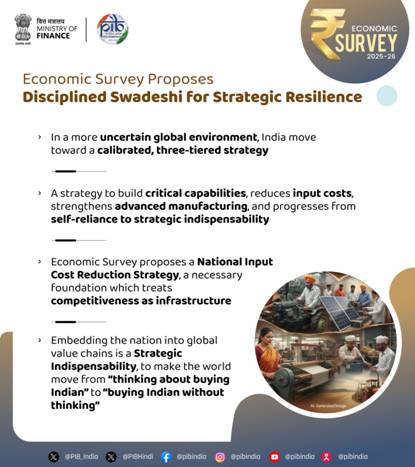
ECONOMIC SURVEY PROPOSES DISCIPLINED SWADESHI FOR STRATEGIC RESILIENCE: A THREE TIERED FRAMEWORK FOR STRATEGIC INDIGENISATION
NATIONAL INPUT COST REDUCTION STRATEGY: A NECESSARY FOUNDATION WHICH TREATS COMPETITIVENESS AS INFRASTRUCTURE
EMBEDDING THE NATION INTO GLOBAL VALUE CHAINS IS A STRATEGIC INDISPENSABILITY, TO MAKE THE WORLD MOVE FROM “THINKING ABOUT BUYING INDIAN” TO “BUYING INDIAN WITHOUT THINKING”: ECONOMIC SURVEY
India has performed well in recent years, but the global environment confronting it today is materially different and unsettled. In a world characterised by geopolitical fragmentation, strategic trade, volatile capital flows, and rapid technological disruption, the central constraint is no longer macroeconomic management alone. It is the depth and quality of state capacity.
In this uncertain global environment, India’s approach is to move beyond blanket import substitution toward a calibrated, three-tiered strategy that builds critical capabilities, reduces input costs, strengthens advanced manufacturing, and progresses from self-reliance to strategic indispensability.
“In this setting, Swadeshi becomes inevitable and necessary. It is both a defensive and offensive policy lever to ensure continuity of production in the face of external shocks and to build enduring national capabilities that reinforce economic sovereignty,” says the Economic Survey 2025-26 tabled in Parliament today by Union Minister for Finance and Corporate Affairs, Smt. Nirmala Sitharaman.
The Economic Survey frames this transition as a movement from strategic resilience – the ability to absorb shocks and preserve stability towards strategic indispensability – the ability to become a source of reliability, capability, and value for others.
SWADESHI AS A DISCIPLINED APPROACH TO INDIGENISATION:
Swadeshi must be a disciplined strategy, as not all import substitution is either feasible or desirable. “Protection without productivity-enhancing investment, capability upgrading, and export orientation creates fragility rather than strength,” states the Economic Survey.
The Survey proposes a three-tiered framework for indigenisation so that intervention builds long-run capability rather than preserve inefficiency. The three tiers are as follows:
- Critical vulnerabilities with high strategic urgency
- Economically feasible capabilities with strategic payoffs
- Low strategic urgency or high-cost substitution
These tiers are not static; rather they evolve as technologies mature, costs decline, or geopolitical conditions change, culminating indigenisation towards export capability, a distinguishing feature of intelligent import substitution.
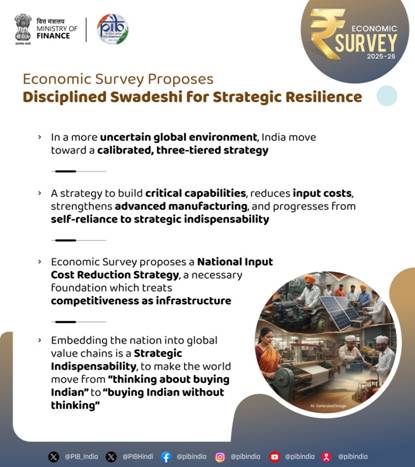
The Survey examines a National Input Cost Reduction Strategy that treats competitiveness as infrastructure, recognising affordable and reliable inputs as foundational to manufacturing, exports, and employment and elevated input costs as a diffuse and persistent economy-wide penalty. “For India, if indigenisation is to strengthen resilience without eroding exports, it must be paired with systematic input-cost reduction,” says the Economic Survey.
Advanced manufacturing becomes decisive in capability building, as it exposes weaknesses that sheltered activities can carry for long periods. It acts as a stress test for both the state and firms, in which predictable rules, operational reliability, and institutional follow-through are conditions for survival.
Drawing on East Asian experience, the Survey highlights the role of the entrepreneurial state in supporting the progression. The industrial policy has a far better chance of success with institutional reforms featured with outcome-oriented bureaucracy, failure tolerance with learning (errors are acceptable; stagnation is not) and credible withdrawal of support (exit is as important as entry).
While resilience is a necessary objective, it is not a sufficient one in itself. A nation that merely absorbs shocks remains reactive. A nation that shapes outcomes becomes influential, a higher bar than self-sufficiency and a more demanding aspiration than resilience. The Economic Survey frames a progression from Swadeshi to Strategic Resilience to Strategic Indispensability, in which intelligent import substitution invests in national strength and ultimately embeds India in global systems, so that the world moves from “thinking about buying Indian” to “buying Indian without thinking.”